Soft-Wash Roof Cleaning
Concrete tile, shingle, and the mansard bands and fascia on flat-roof condominium buildings, cleaned with low-pressure chemical application.
Boynton Beach is not one housing stock, it is four stacked on top of each other. Mid-1960s low-rise condominium buildings east of I-95. Single-story CBS ranches from the Leisureville era. Golf communities built from about 1979 through the 1990s. Valencia-style builds from the 2000s, plus newer construction near the marina. Each era put a different surface on the building, and each fails differently under pressure.
Boynton Beach is not one housing stock, it is four stacked on top of each other. Mid-1960s low-rise condominium buildings east of I-95. Single-story CBS ranches from the Leisureville era. Golf communities built from about 1979 through the 1990s. Valencia-style builds from the 2000s, plus newer construction near the marina. Each era put a different surface on the building, and each fails differently under pressure. We soft wash anything porous, coated or membrane-covered, which here is most of it.
We work throughout Boynton Beach, including Leisureville, Sterling Village, Village Royale on the Green, Hunters Run, Quail Ridge, Indian Spring, Aberdeen, Knollwood, Golfview Harbour Estates, Cascade Lakes, Palm Isles, and the Valencia and Canyon communities. HOA, condominium association, and commercial properties welcome.
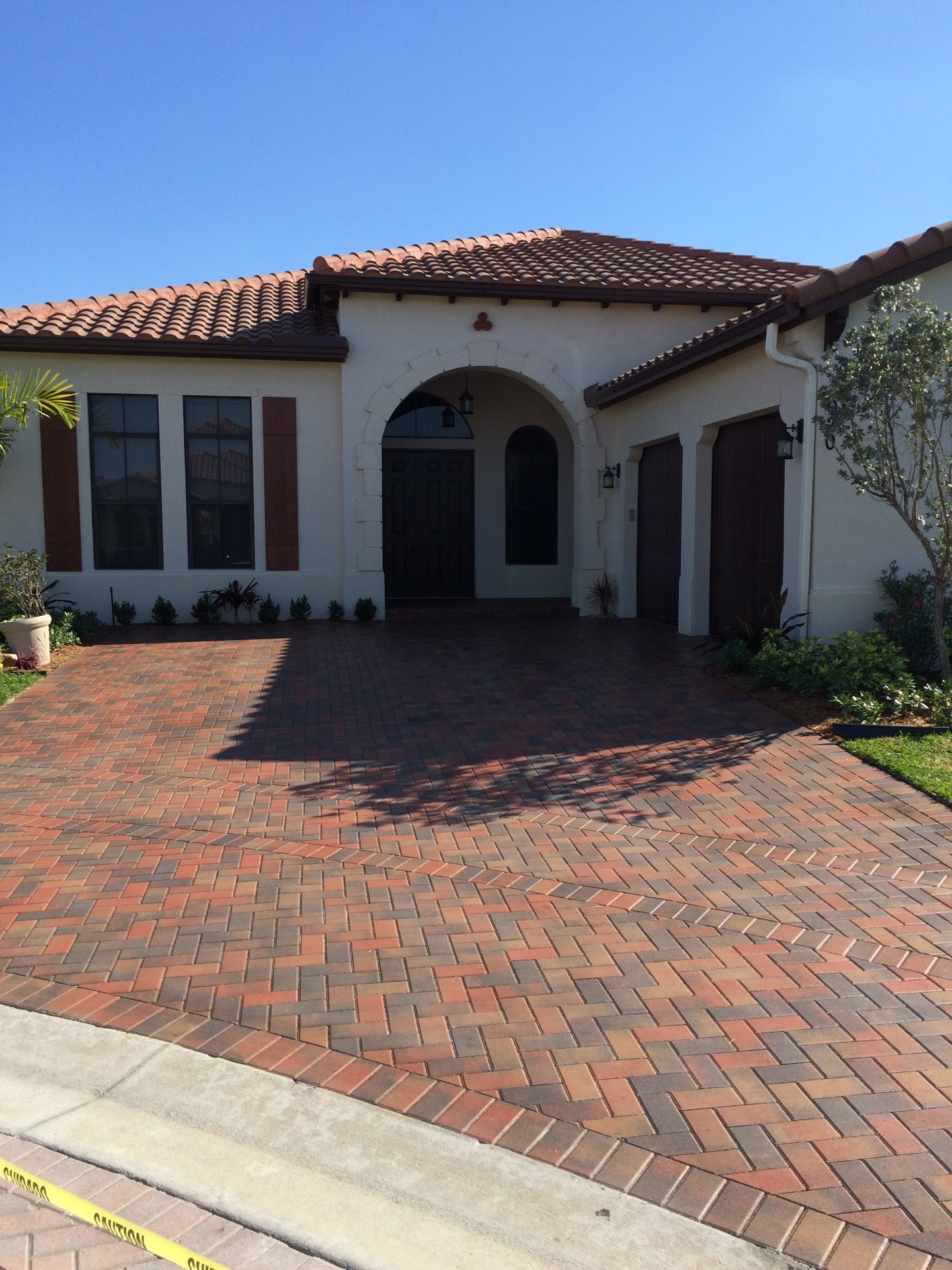
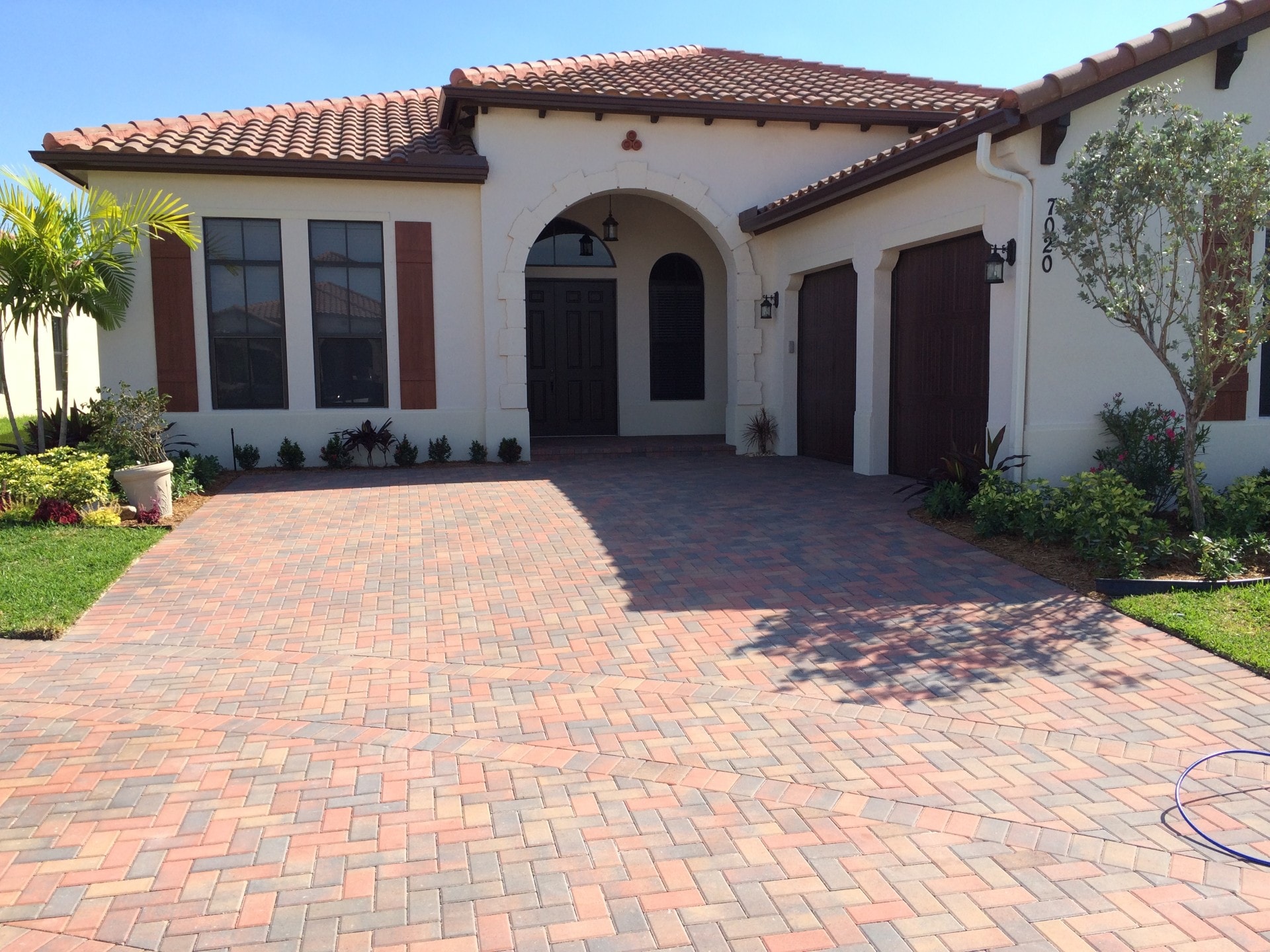
Brick paver driveway pressure washing and sealing - Boynton Beach, FL
That black streaking is Gloeocapsa magma, a cyanobacteria rather than mold or dirt. It arrives airborne, lands on a roof that stays damp, and feeds on the limestone filler in shingle and the porous surface of concrete tile. What it needs is a long damp window. Three things here supply one.
Salt off the Intracoastal. The city's eastern boundary is the Intracoastal Waterway, not the ocean. The barrier island across from it is Ocean Ridge, and Boynton Beach's own Oceanfront Park sits over there inside that town's limits. Salt aerosol carries across that water onto roofs and screen frames, and salt is hygroscopic: it pulls moisture from the air and holds it against the surface. A salted roof stays wet longer than the same roof three miles west.
Sixty years of canopy over two-story buildings. The neighborhoods east of I-95 built out in the 1950s and 1960s, and the ficus, black olive and mahogany planted with them are mature now. On a two-story building that canopy is not shading the yard, it is sitting on the roof. Black olive is the worst: the fruit drops and stains walkways rust-brown. Not permanent, but it does not come off with pressure.
Roof geometry. A tile roof sheds a rainstorm in minutes. A flat or low-slope condominium deck does not shed, it drains, slowly, through internal drains and scuppers, and the low spots hold water for hours. Standing water on a warm roof is the best growth medium there is. Those buildings then carry a mansard band of tile or shingle to hide the flat deck, so one building has both problems.
Pressure on concrete tile breaks the glaze, lifts the color coat and drives water under the flashing. We use low pressure and let the chemistry work.
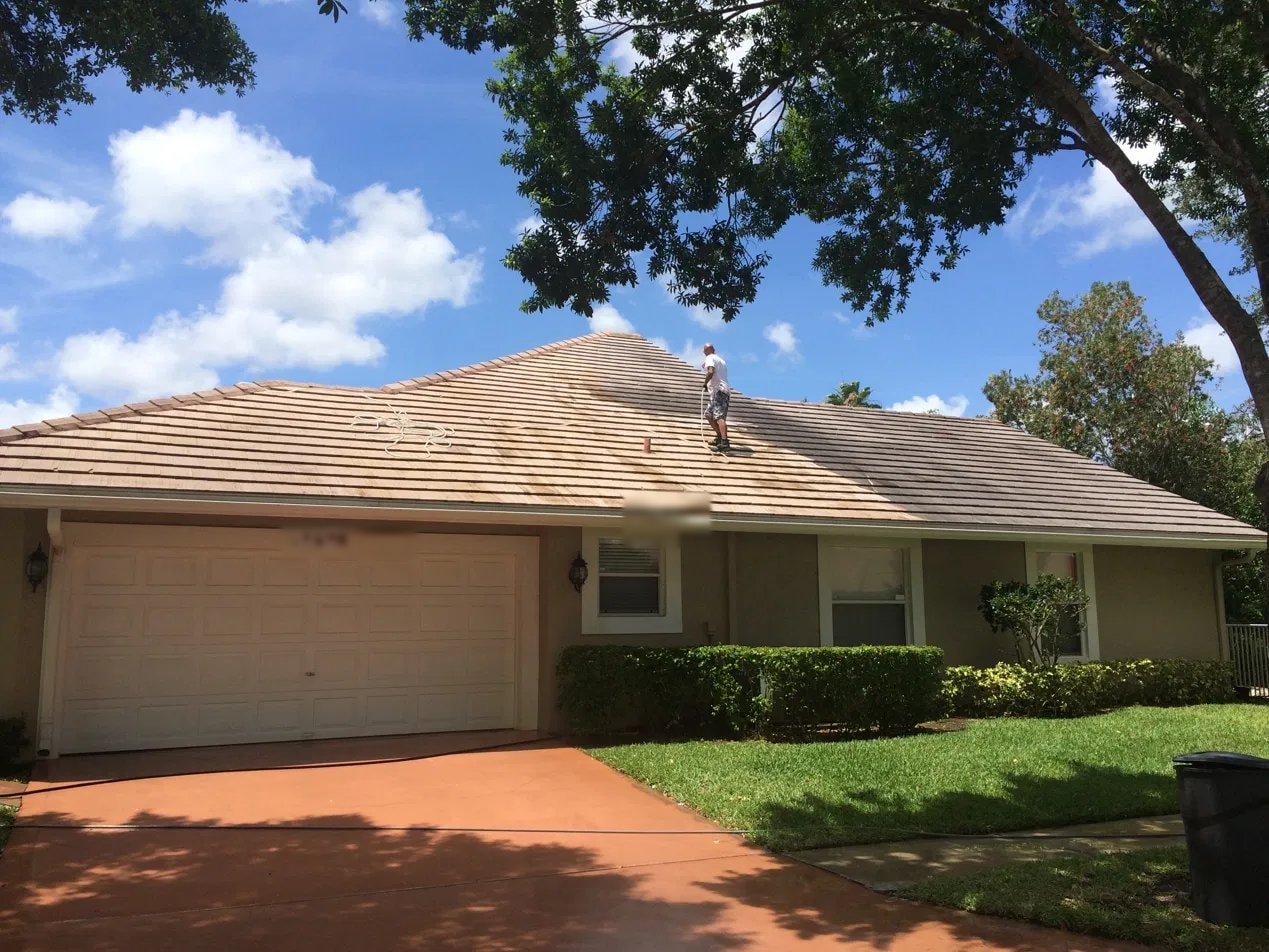
Soft-wash roof cleaning - flat tile roof, Boynton Beach, FL
On a single-family house with gutters, the solution is captured at the downspout into collection bags and never reaches the beds. Without gutters, we tarp the property and a ground technician wets down plants, walls and windows, anywhere wind could carry the mist.
Multi-family work changes the problem. A flat-roof building has no downspouts to bag. It discharges through scuppers and internal leaders, so containment happens at the ground-level outlet, and we locate every one on the walk-through. Your neighbor is also four feet away, so ground-floor patios, lanais, potted plants and mobility equipment get moved or covered. Hibiscus, bougainvillea and orchids get tarped either way.
The ground technician stays on the ground throughout, working ahead of the drift. That is the whole reason there are two of us on a job.
If you live in one of the older condominium buildings, your roof is not a roof in the sense most homeowners mean. It is a membrane: gravel-surfaced built-up roofing, modified bitumen cap sheet, or single-ply on a newer replacement. All three are waterproofing systems rather than wearing surfaces, and all three are ruined by what a careless contractor does automatically. Apply pressure, and walk on it.
Pressure on a membrane does not clean it, it opens it. High pressure strips the granules off a cap sheet, lifts the laps where sheets overlap, and drives water into the insulation, where nobody finds it until a top-floor ceiling starts staining. On a roof with no slope, that water has nowhere to go. Foot traffic is the other half: modified bitumen softens in afternoon heat, and a boot print becomes a permanent ponding spot.
So here is the part nobody tells a board before they sign. On most older Boynton Beach condominium buildings the membrane field is a roofing contractor's maintenance item, not a cleaning item. What we clean is everything visible from the ground: the mansard band, fascia and soffit, parapets and coping, stair towers, catwalks, railings and walls. That is what changes how a property looks and what answers a code notice. If somebody quoted your association a price to pressure wash the roof deck, ask what system is up there. If they cannot tell you, that is your answer.
We will say when the right call is a roofer rather than us. That costs us a job occasionally. It has never cost us an association.
Broom-finished gray concrete covers the older single-family stock in Leisureville, Golfview Harbour Estates and the streets around them. Here is the honest expectation: a 1968 driveway cleans up to clean, not to new. Anyone promising new will reach for pressure, which leaves a wand-striped slab with the cream layer blown off. We run a rotary surface cleaner and tell you up front where the ceiling is.
Condominium parking lots and walkways are a different job, priced differently. Lots have oil drips that need degreasing before washing rather than instead of it, and painted striping that pressure will strip. The complexity is logistical: the lot gets cleared in sections, which means notices, cars moved, and residents who cannot move one on short notice.
Brick pavers cover nearly every 1990s and 2000s build here. Joint sand comes out with the dirt on any paver cleaning, which is physics rather than damage, and we tell you up front whether re-sanding is in your quote or priced separately. Sealing goes down only on a fully cured, fully dry surface. Travertine and marble on the newer marina-area construction get a neutral-pH clean, never acid.
On the western side of the city, well irrigation puts iron in the water and sprays an orange arc across stucco and driveways. Chlorine will not touch it and pressure etches the concrete around it, so rust removal is quoted separately, and the stain returns until the sprinkler head is adjusted.
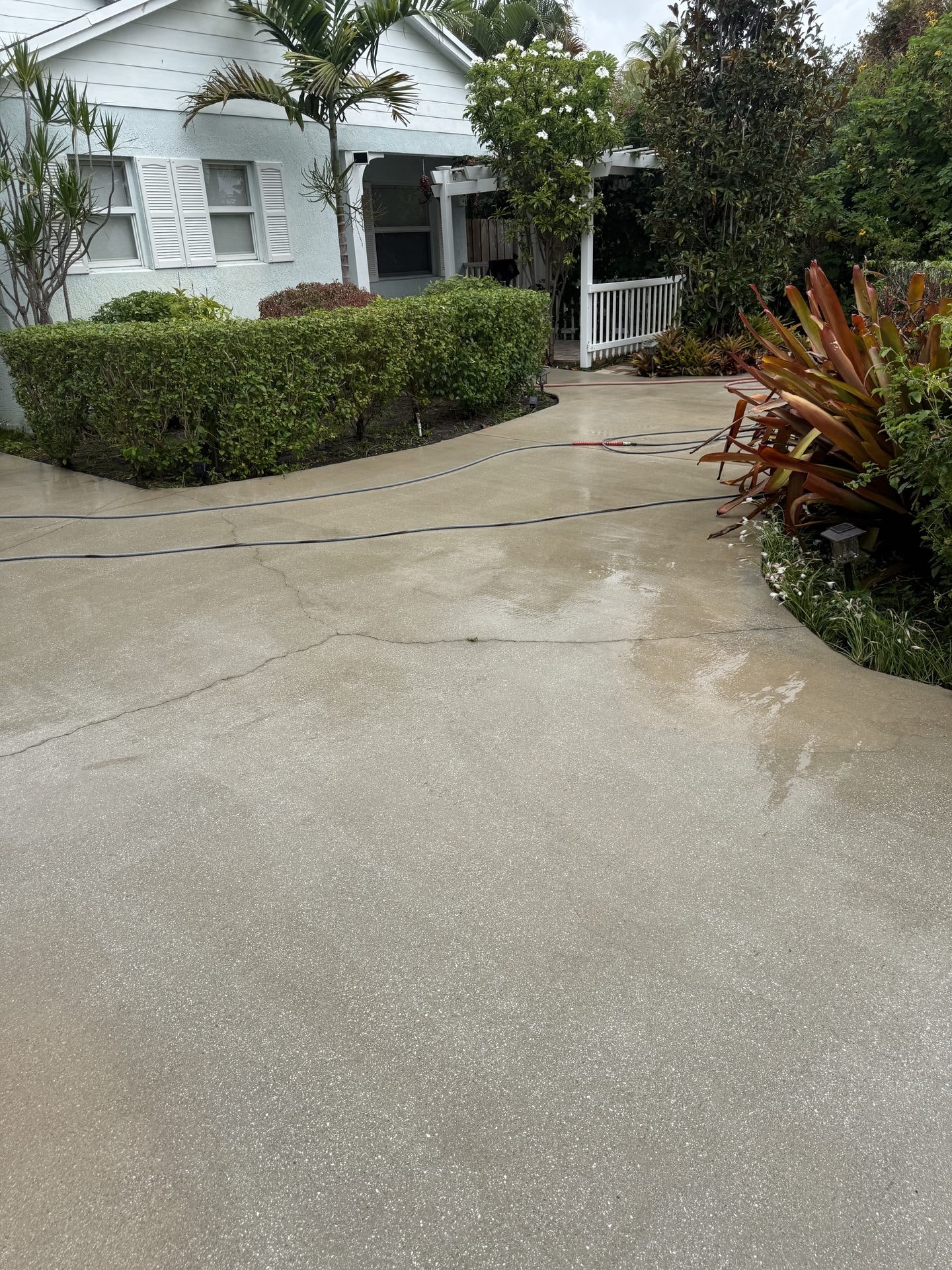
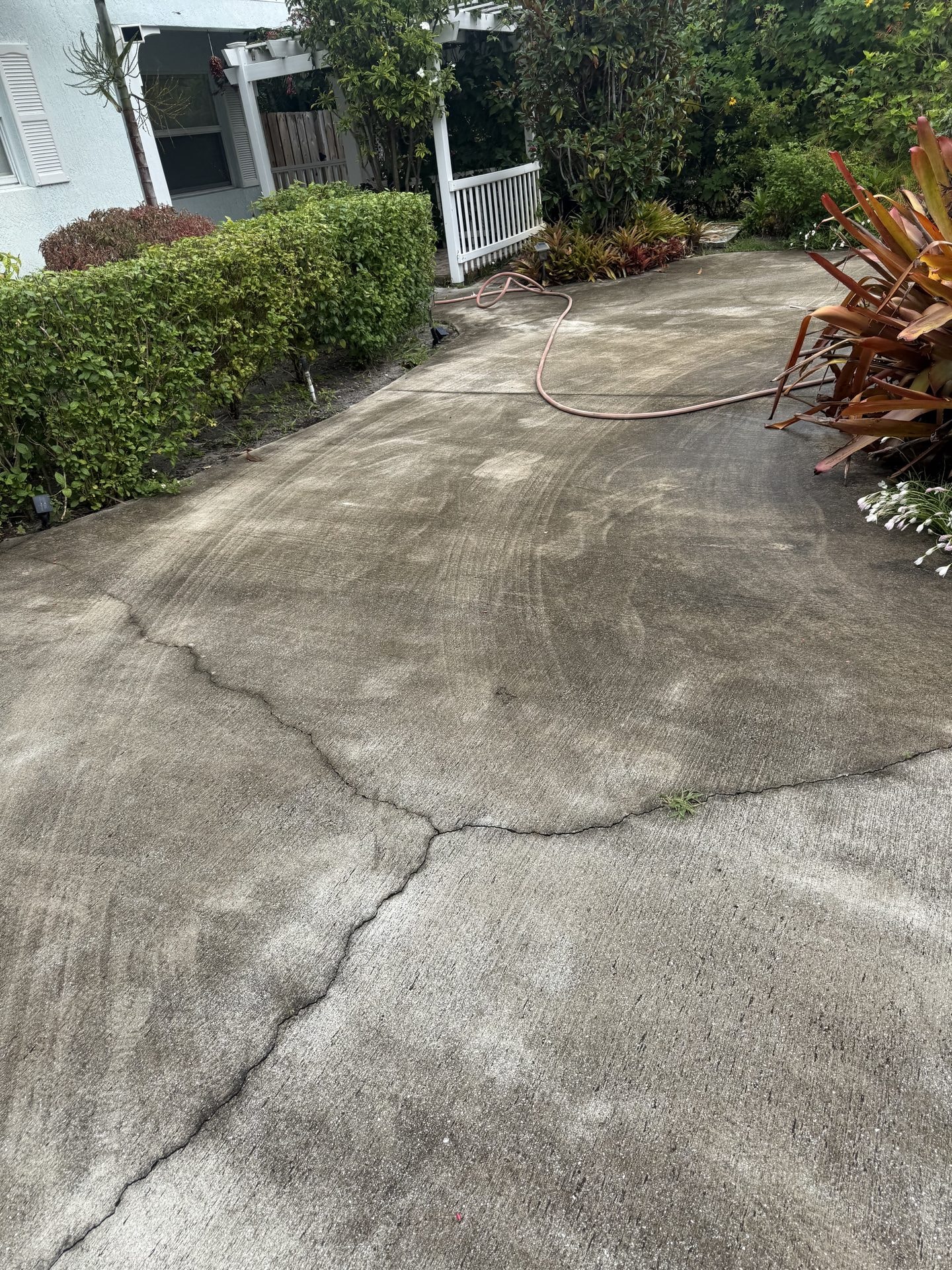
Concrete driveway pressure washing - Boynton Beach, FL
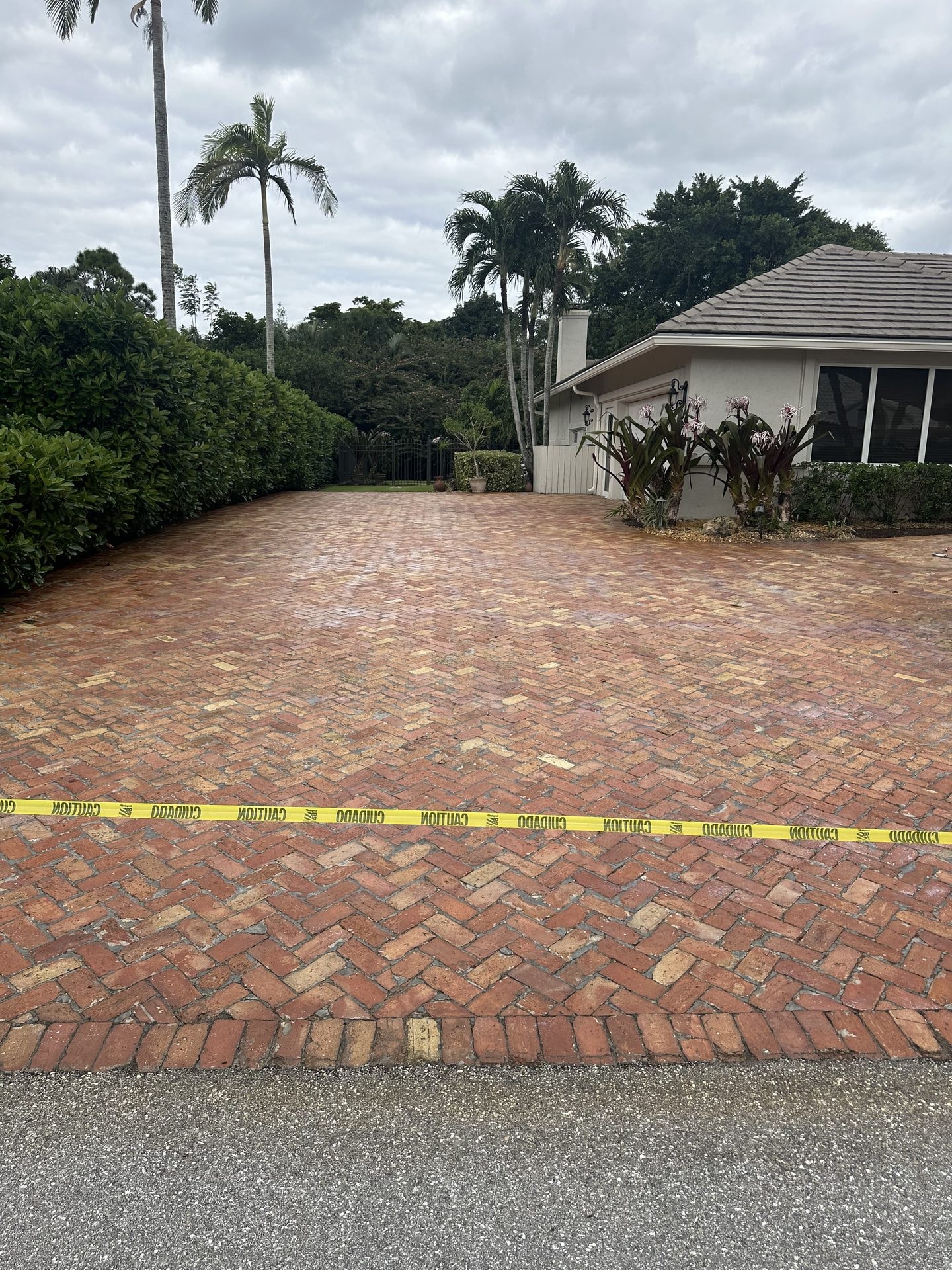
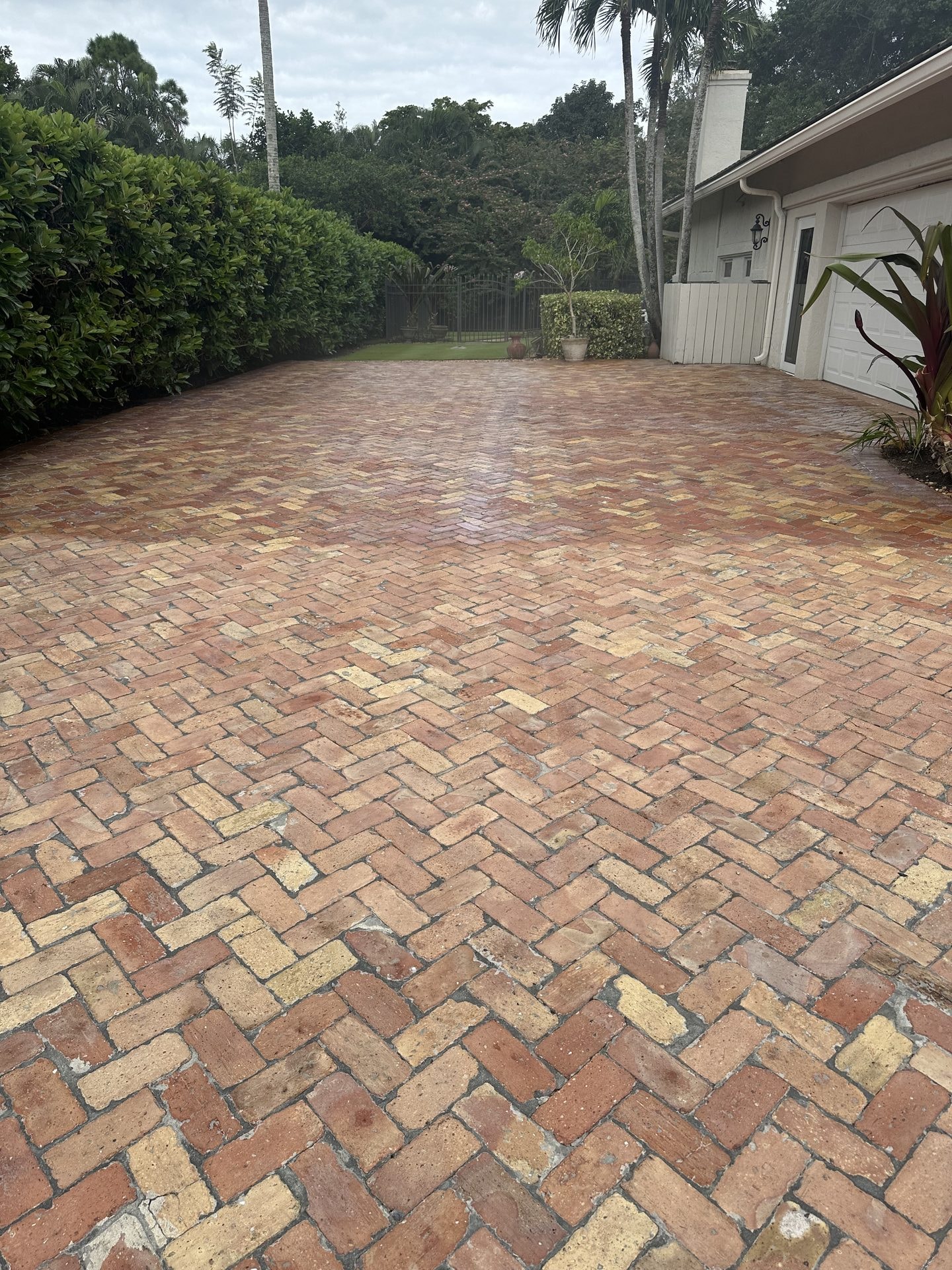
Old Chicago brick paver pressure washing and sealing - Boynton Beach, FL
Boynton Beach is a CBS city. Concrete block and stucco is what the postwar boom built here, so your walls are almost certainly painted block under a stucco finish coat.
Textured stucco holds mildew down in the texture rather than on the surface, which makes this a dwell-time and chemistry problem rather than a pressure problem. Turning the pressure up gets you a clean patch and a stripped patch beside it, and it forces water behind the finish, which you find out six months later when the paint blisters.
Older paint films chalk. On a building not repainted in twenty years, the paint has oxidized into a loose layer that comes off on your hand. It cleans, but only down to a chalked film. We will tell you when you are looking at a paint job rather than a wash.
Jalousie and awning windows are the detail almost nobody mentions. If your building is 1960s or 1970s vintage, those overlapping glass slats in a crank frame were never watertight and they are sixty years old now. Any pressure directed at one puts water onto the floor inside the unit. We work those elevations with a controlled low-pressure rinse, and we would rather ask a resident to close a window than explain a wet carpet.
We also watch soffit vents, because water driven up into one ends up in the attic. The street-facing wall usually looks fine. It is the shaded north and east walls where the mildew lives.
Screen enclosures cut airflow and hold moisture, so the deck under a cage grows a biofilm that is slick before it is visibly dirty. If your deck is slippery after rain, that is algae, and in a community where many residents are over sixty-five it is a fall risk before it is a cosmetic problem. On a community pool deck, traction is the deliverable.
Kool Deck is everywhere in the 1960s and 1970s pools here, and it is the surface people wreck. It is a thin textured topping over the slab, pressure blows it off in sheets, and it gets soft washed.
Boynton Beach also has a surface most cities do not: shuffleboard courts. Leisureville and Village Royale on the Green both have them, and so do many smaller associations. A shuffleboard court is a smooth troweled and coated slab, and the entire point of it is the slide. High pressure roughens that finish and the court is finished as a court, though it will still photograph well. Courts get low pressure and soft-wash chemistry, as do bocce, tennis and pickleball surfaces, and cage frames and screens.
Boynton Beach enforces exterior property maintenance more actively than most cities in the county. Local coverage in early 2026 quoted homeowners describing the city's code compliance as feeling like living under an HOA even though they are not in one, with citations reported for exterior and roof discoloration past a set threshold. Here the city letter is a real possibility, and it comes with a fixed window to correct. A deadline changes how we schedule rather than what we charge, so mention the date when you call. We respond to every estimate request within 24 hours.
The part that catches people: if you live in a condominium or townhome, the notice may not come to you at all. On a multi-family building the exterior is usually a common element, so the citation goes to the association. The person who got the letter, the person who pays, and the person behind the dirty wall are three different parties.
Swales are the cut between sidewalk and street. They collect silt, they grow, and they are the first thing a drive-by notices.
This is the work Boynton Beach is built for.
The city holds one of the densest concentrations of condominium and 55+ association property in Palm Beach County. Sterling Village dates to 1966 and 1967, about 840 units. Village Royale on the Green was built between 1969 and 1983, about 880. Boynton Leisureville went up between 1975 and 1987, about 892 homes. Hunters Run built out between 1979 and 2003, roughly 1,650 homes. Most of the exterior surface here is owned by a board and paid for out of a budget line.
The unit owner usually cannot authorize the work. If the roof, walls, catwalks and walkways are common elements, no owner can hire anybody to clean them. The path runs through the board or the manager it employs, so put a written proposal in front of that manager. We produce one addressed to the association at no charge, and you do not have to sit on the board to request it.
Approved vendor status and paperwork are the gate. Management companies here run approved-vendor lists and portals, and the requirements are consistent: a certificate of insurance naming the association as additional insured, general liability at the limit its counsel requires, workers' compensation coverage, a W-9 so the association can issue a 1099, and a signed scope of work. We send that packet with the proposal, because a board comparing three bids should not have to chase one for a COI.
Boards also move on a calendar. Proposals get reviewed at a meeting, not on a phone call, and the money usually has to already exist in an approved budget. Boards working through Florida's milestone inspection and structural integrity reserve study requirements for buildings of three or more habitable stories are budgeting tighter than they used to. We price by building and by phase, so a board can fund what it can this year.
Residents have to be scheduled, not just notified. Doing a whole community means posted notices on every affected building, lanais cleared, cars relocated in sections, and pool closures coordinated with the amenity calendar. It also means a plan for residents who cannot move a car without help, which here is not an edge case.
Boynton Beach commercial work runs along a handful of corridors: Congress Avenue from Boynton Beach Boulevard north past the Boynton Beach Mall and Boynton Town Center; the office and light-industrial buildings in Quantum Park off Gateway Boulevard; Old Boynton Road and Woolbright Road; Federal Highway through downtown and the marina district; and the medical offices around Bethesda Hospital East on South Seacrest Boulevard. Storefronts, plazas and restaurant patios get scheduled after hours, or on a standing semiannual schedule.
Sports courts at community clubhouses are their own job. A tennis, pickleball or basketball court is an acrylic coating over a slab and the coating is the entire asset, so high pressure lifts it. Courts want soft washing every six months, and algae on a court is a traction question rather than a looks question.
Post-construction covers the newer downtown and marina-district builds: the dust, mortar splatter and adhesive a builder's final clean does not touch.
Leisureville, Sterling Village, Village Royale on the Green, Hunters Run, Quail Ridge, Indian Spring, Aberdeen, Knollwood, Golfview Harbour Estates, Sky Lake, Lake Boynton Estates, Boynton Lakes, Cascade Lakes, Palm Isles, Majestic Isles, Greentree Villas, Chanteclair Villas, Citrus Glen, Nautica, Tivoli Lakes, the Canyon communities, and the Valencia communities.
If your community is not on that list, call and ask.
Boynton Beach has two scheduling calendars, depending on who owns the surface.
For association and multi-building work, the window is May through September. Seasonal occupancy is lowest, so there are fewer cars to relocate and fewer residents inconvenienced. Boards also set budgets in late summer and fall, so a proposal that lands before the budget meeting has somewhere to go. One that lands in January competes against money already allocated.
For single-family homes, October through December is right. Dry season is starting, the surface stays clean longer, and you are ahead of the holidays.
On concrete tile here, roofs run every eighteen to twenty-four months. East of Federal Highway and under mature canopy, expect twelve to eighteen. Association exteriors and mansard bands sit on a twelve- or twenty-four-month cycle, and driveways go annually. Community pool decks and sports courts run every six months, a traction interval rather than an appearance interval.
Licensed, Bonded and Insured. BTR #201578066. ThePressureCleaningPeople.Com LLC is an affiliate of Thomas R. Scott GC Inc. (Lic# CGC006883).
Serving South Florida since 2014. Call (561) 907-1333. We respond to every estimate request within 24 hours.
We hold municipal contracts for parks, public facilities, and commercial properties throughout Boynton Beach. The photos below are from a six-day contract at Canyon Park — walkways, pavilion, restroom buildings, waterfront paths, and playground surfacing.
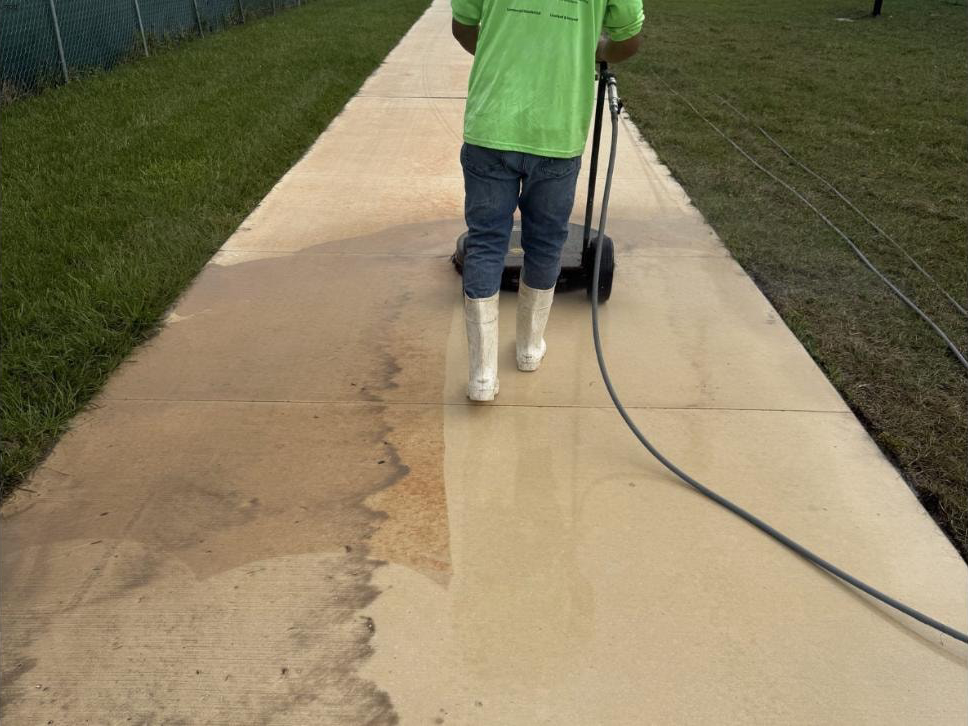
Park walkway pressure washing - Boynton Beach, FL
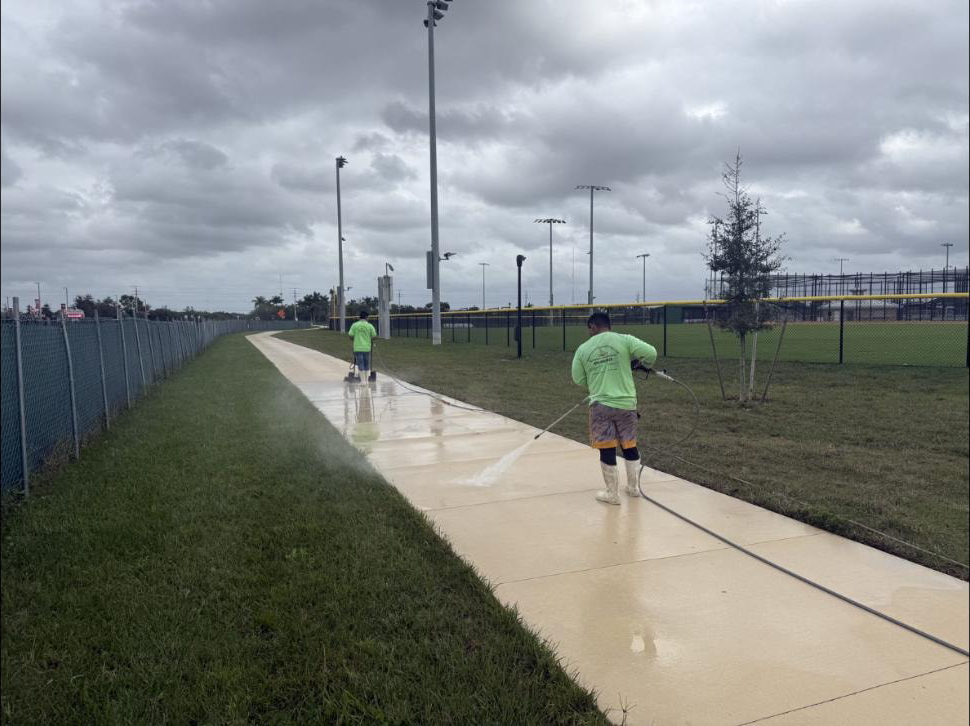
Park walkway pressure washing - Boynton Beach, FL
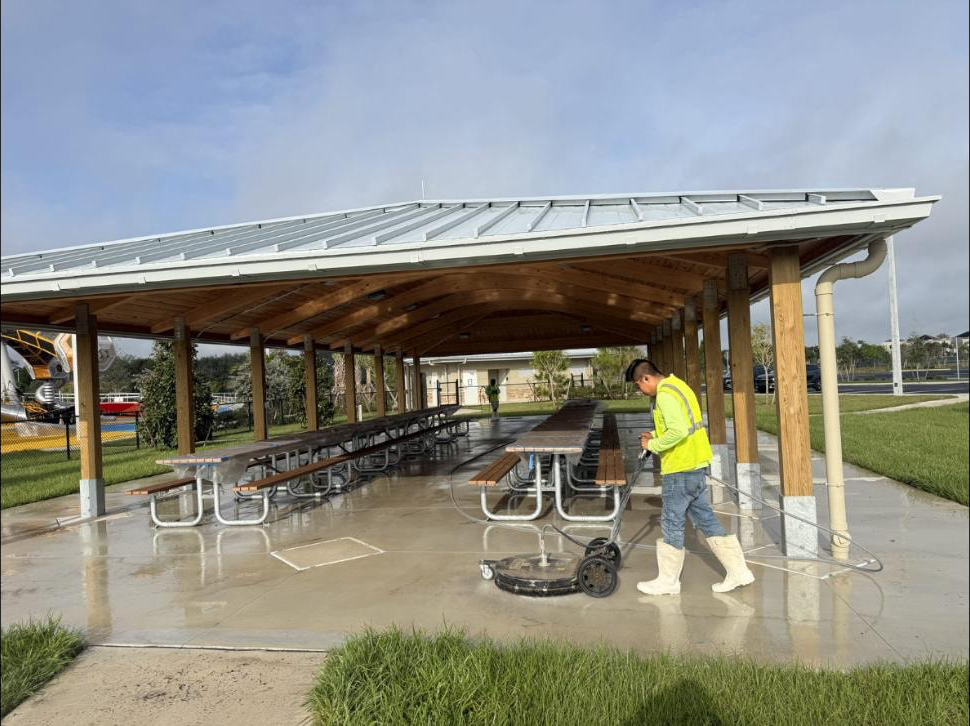
Park pavilion pressure washing - Boynton Beach, FL
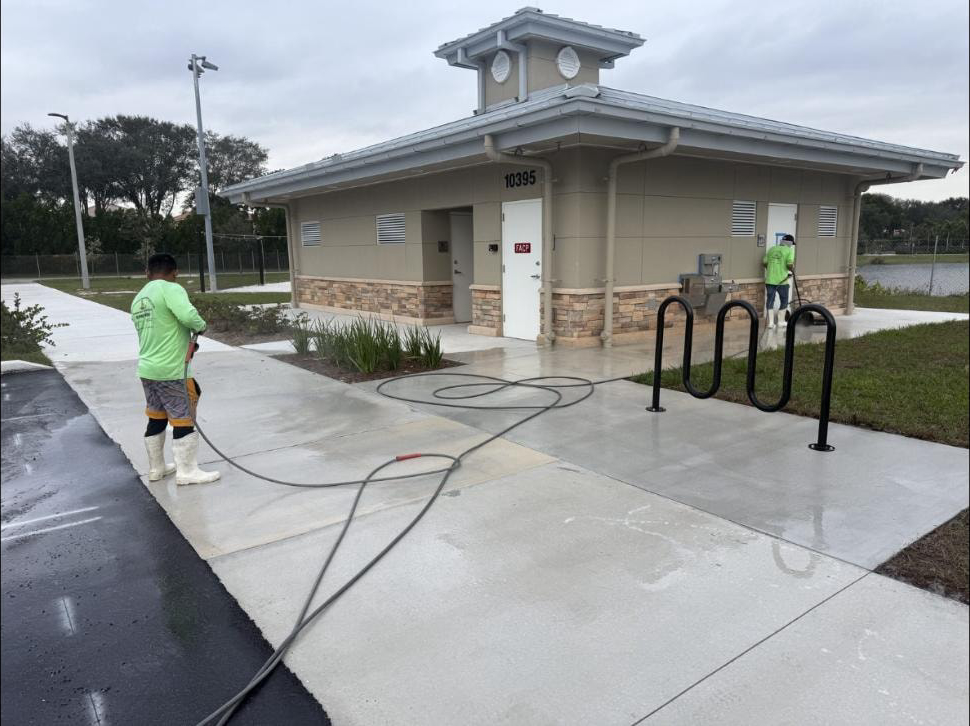
Park restroom building and walkway pressure washing - Boynton Beach, FL
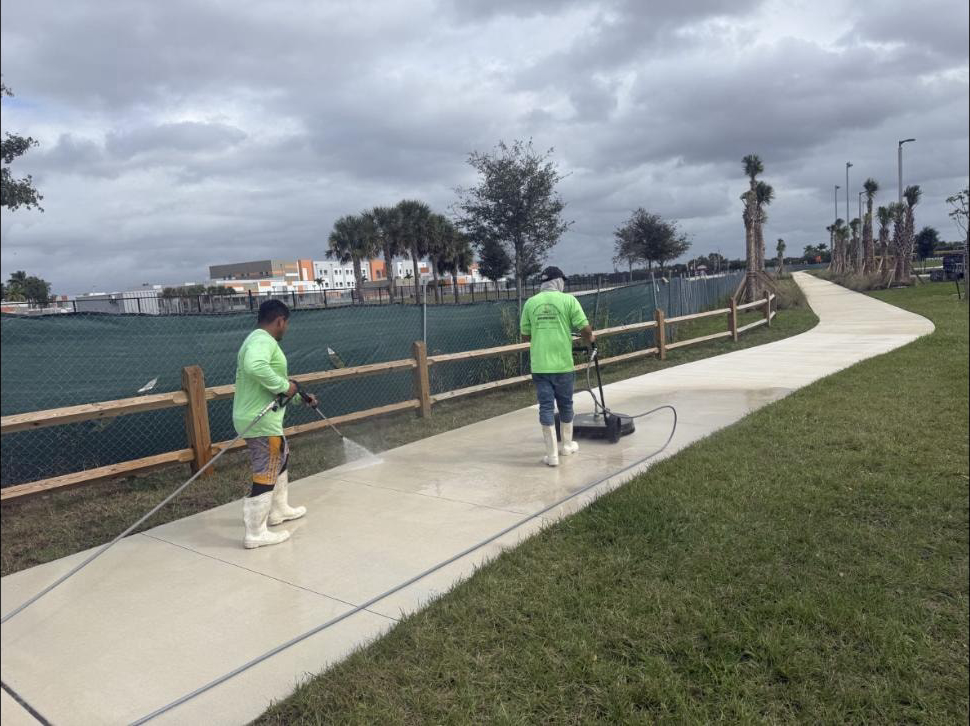
Waterfront park walkway pressure washing - Boynton Beach, FL
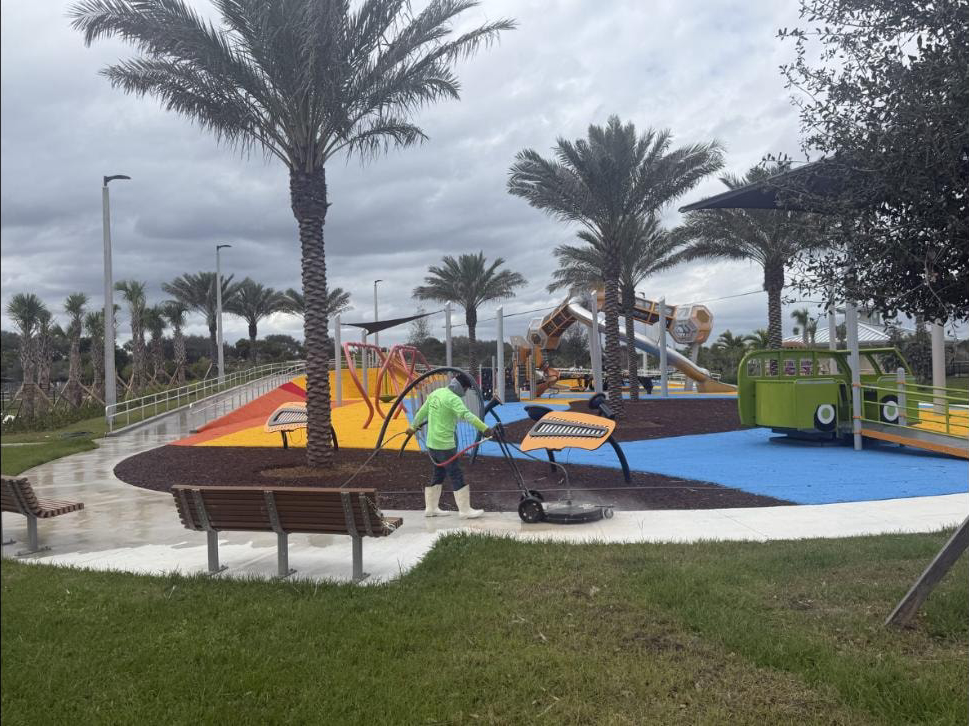
Playground surfacing pressure washing - Boynton Beach, FL
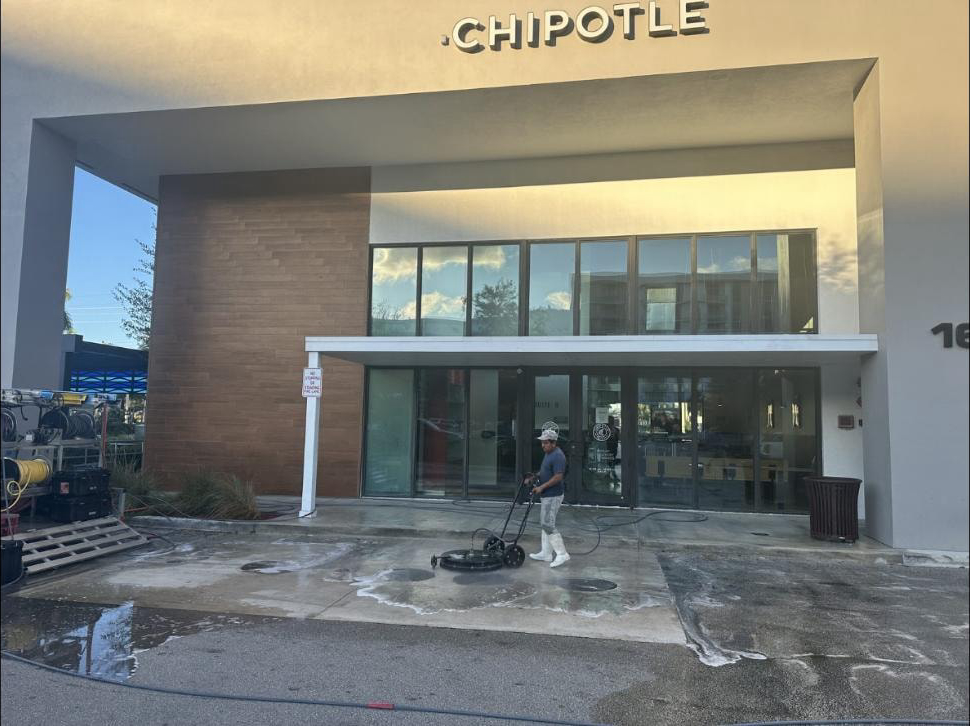
Restaurant entrance pressure washing - Boynton Beach, FL
Concrete tile, shingle, and the mansard bands and fascia on flat-roof condominium buildings, cleaned with low-pressure chemical application.
Painted CBS and textured stucco, single-family and multi-story. No blasting that strips paint or forces water behind the finish.
Interior and exterior window cleaning, streak-free.
Pool cage and lanai screens, plus the salt-driven frame oxidation common east of I-95.
Driveways, association walkways, catwalks, parking lots and pool decks.
Irrigation and hardware rust lifted from concrete, pavers and stucco.
Vinyl, wood and aluminum fences.
Gutters and downspouts cleared, gutter faces cleaned of algae streaking.
Roof Cleaning in Boynton Beach
Soft-wash tile and flat roof cleaning
House Washing in Boynton Beach
Exterior wall and stucco cleaning
Screen Enclosure Cleaning in Boynton Beach
Pool cage and lanai screen cleaning
Driveway & Walkway Cleaning in Boynton Beach
Paver and concrete pressure washing
Sidewalk & Swale Cleaning in Boynton Beach
Concrete sidewalk and drainage swale washing
Sports Court Cleaning in Boynton Beach
Tennis, pickleball, and basketball court washing
Fence Cleaning in Boynton Beach
Soft-wash cleaning for vinyl, aluminum, and wood fencing
Gutter Cleaning in Boynton Beach
Interior clearing plus exterior soft-washing
Post-Construction Cleanup in Boynton Beach
Mortar, overspray, and construction debris removal
We respond to every estimate request within 24 hours. Call (561) 907-1333 or fill out the form below.