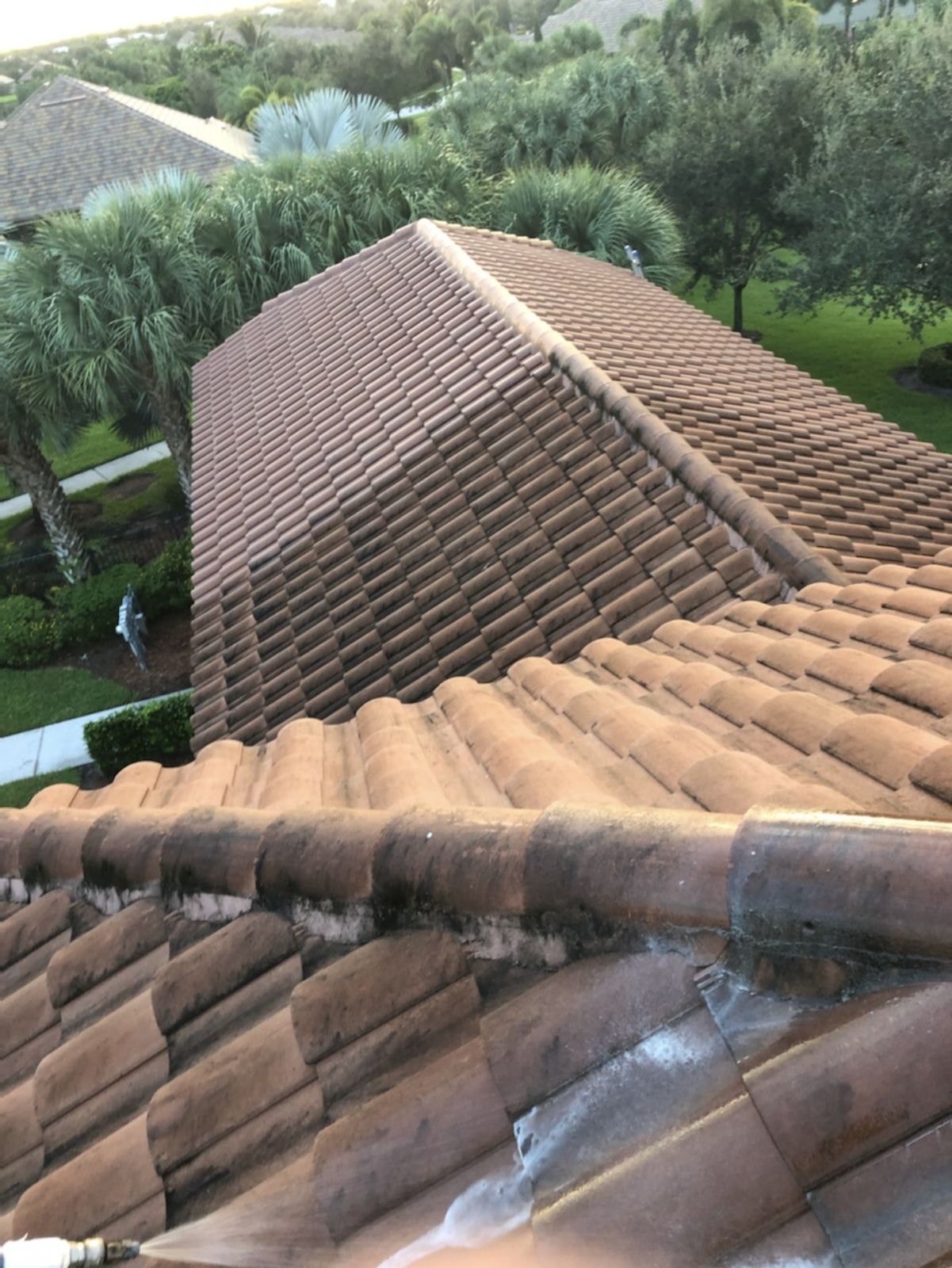
Most tile roofs in Palm Beach County need cleaning every 18 months to three years. That's a wide range, and where your roof falls in it depends less on the calendar than on what's around it.
What Actually Drives the Timeline
The black streaking on South Florida roofs is usually Gloeocapsa magma, an algae that feeds on the limestone filler in roofing material and spreads through airborne spores. It needs moisture to establish. Anything that keeps your roof damp longer shortens your cleaning interval:
- Tree cover. A roof shaded by oak or ficus canopy stays wet for hours after a roof in full sun has dried. Shaded roofs often need cleaning yearly.
- Proximity to water. Homes near the Intracoastal, a lake, or the ocean sit in higher ambient humidity year-round.
- Roof pitch. Low-slope and flat tile holds water longer than steep barrel tile that sheds quickly.
- North-facing slopes. They get less direct sun and dry slower than south-facing sections. It's common to see one side of a roof streaked while the other looks fine.
How to Tell It's Time
You don't need to get on the roof. From the ground:
- Black streaks running down-slope from the ridge
- Dark patches concentrated on shaded or north-facing sections
- Green tint in valleys or where debris collects
- Crusty gray-green growth on tile edges — that's lichen, and it's further along than algae. Lichen roots into the surface and takes more work to remove.
If you're seeing lichen rather than just streaking, you've waited longer than ideal.
Why Waiting Costs More
Algae and lichen aren't only cosmetic. Organic growth holds moisture against the roofing material, and lichen actively bonds to the surface. On older tile, aggressive growth left in place for years makes eventual cleaning harder and riskier, because more has to be lifted off a surface that's had more time to weather.
There's also the resale angle. A streaked roof reads as deferred maintenance to a buyer or an inspector, whether or not the roof is structurally fine.
What Cleaning Should Look Like
Tile should be soft-washed, not pressure-washed. Soft-washing uses a low-pressure chemical application that kills algae and lichen at the root, then rinses gently. High pressure on tile cracks it, strips the glaze, drives water under the flashing, and in many cases damages the tile outright.
If someone quotes you a roof cleaning and the plan involves a pressure washer at working pressure, that's the wrong method for tile.
Not sure where your roof sits on the timeline? We'll take a look and tell you honestly — including if it can wait. Request a free estimate or call us at (561) 907-1333.