Why Basketball, Tennis, and Pickleball Courts Should Be Soft Washed Every Six Months
8 min readTony Schilling
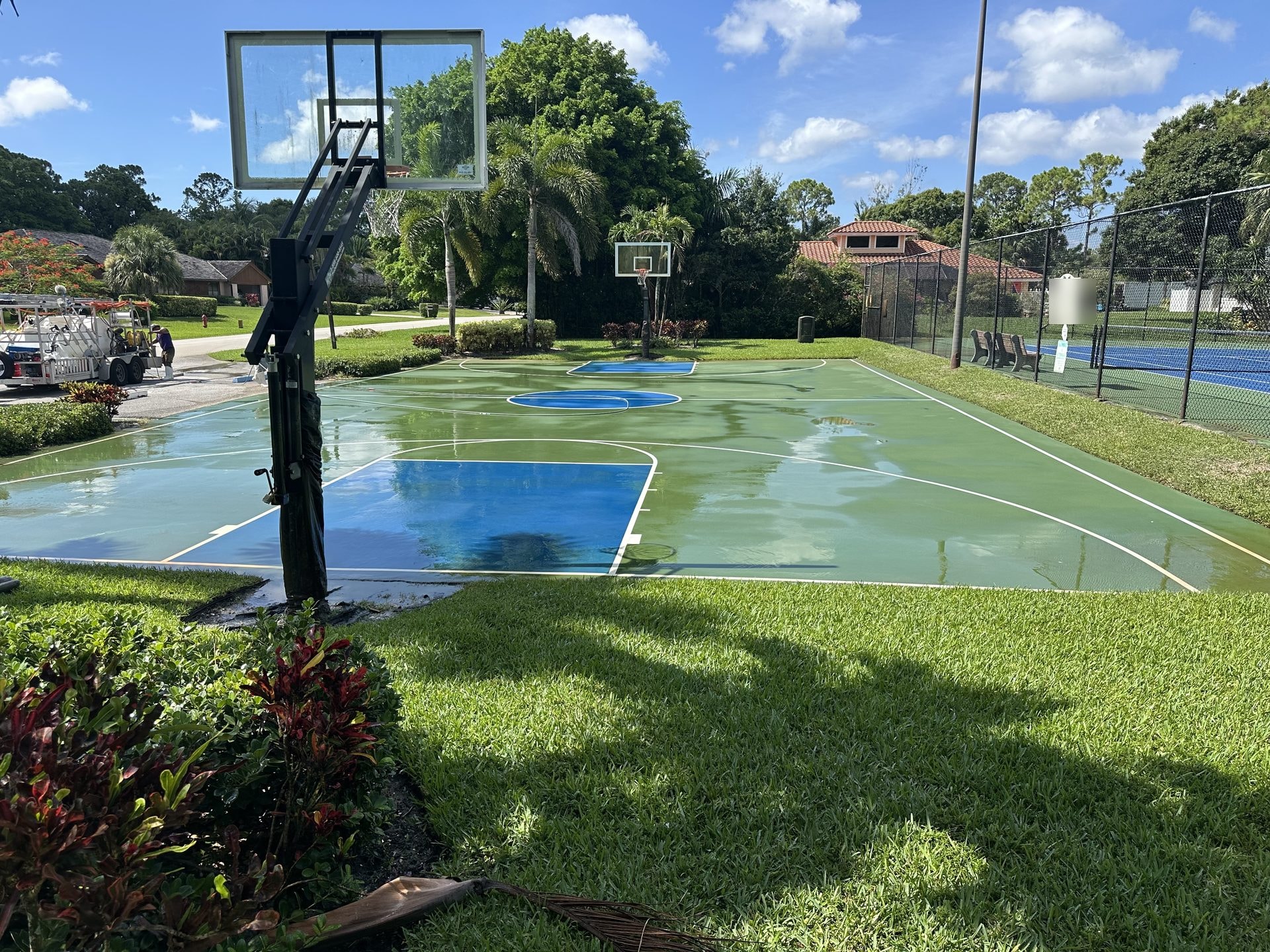
A finished court photographed immediately after soft washing, which is why the surface is still wet.
A sports court is one of the most expensive square-foot surfaces on any property — and one of the most neglected. Roofs get attention because people can see the streaks from the street. Driveways get attention because they are the first thing a guest walks on. Courts sit out back, get played on twice a week, and quietly turn green until somebody slips.
In Palm Beach, Broward, and Martin Counties, that process moves faster than most owners expect. Here is what is actually happening on the surface, why a pressure washer is the wrong answer, and why a six-month cleaning cycle is the number that makes sense in this climate.
What's Actually Growing on Your Court
The dark patches, the green film, the black streaks near the fence line — that isn't dirt. It's biological growth: algae, mildew, mold, and lichen feeding on moisture and the organic film that settles on the surface.
South Florida gives that growth everything it needs:
Humidity year-round, with heavy dew most mornings even in the dry season
A five-month rainy season that keeps the surface damp for weeks at a stretch
Tree canopy and shade from oaks, ficus, and palms, which slow drying and drop tannin-heavy debris
Irrigation overspray that wets the court edges on a timer, every single day
Pollen and airborne organics that give algae a food source on the textured acrylic
Acrylic court coatings are intentionally textured — that grit is what gives players traction. It's also a perfect anchor for spores and a perfect trap for the soil they feed on. Once growth establishes in that texture, it doesn't rinse off with a hose or wear off under foot traffic. It spreads.
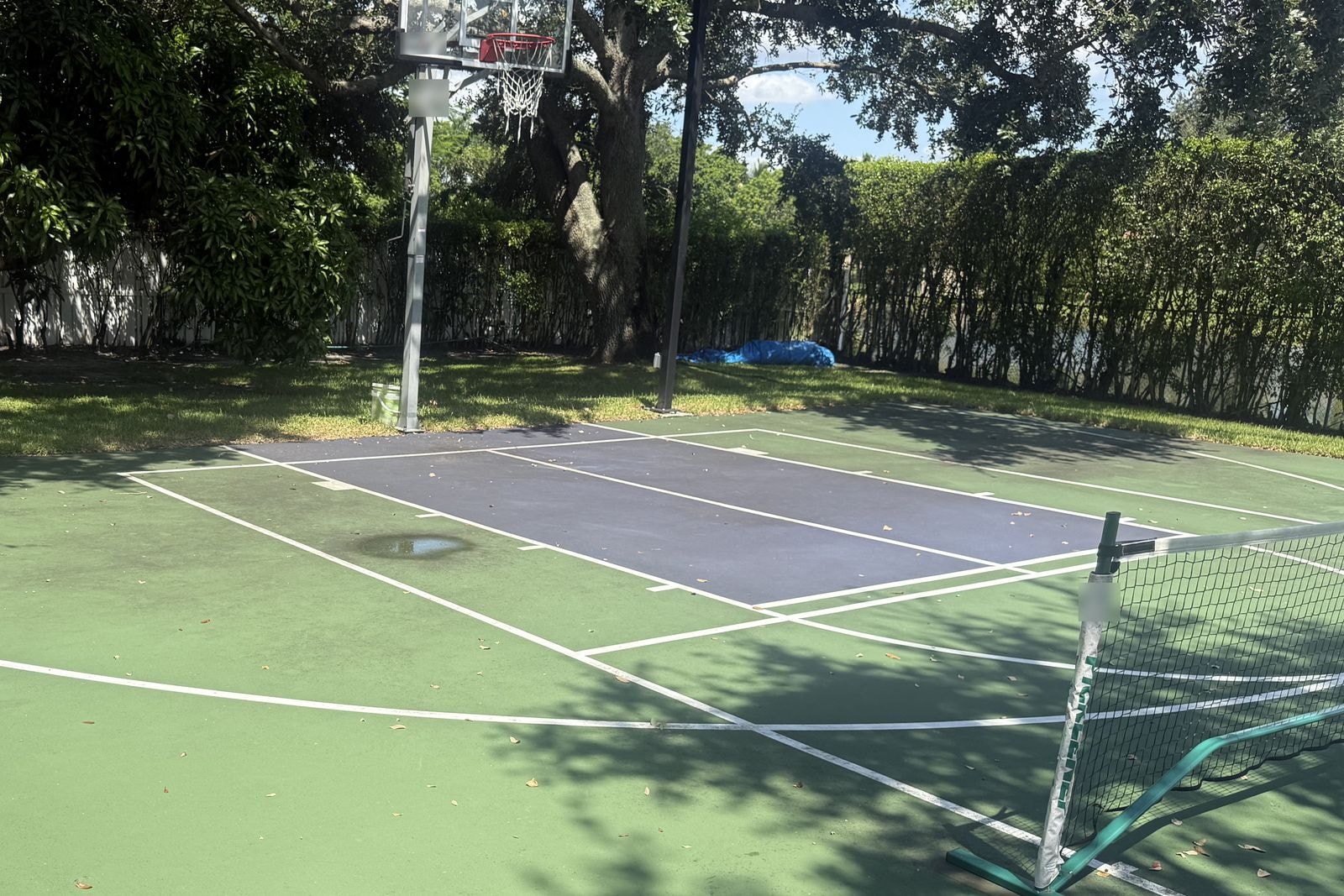
Algae and organic growth on a sports court surface — the condition soft washing is designed to address.
Why Pressure Washing Is the Wrong Tool for a Court
This is the part most property owners get wrong, and it's expensive.
A tennis, pickleball, or basketball court finished with an acrylic color coat is a layered coating system — usually a resurfacer, one or more filler coats, then color coats, then line paint. It's thin. High-pressure water strips it.
What high PSI does to a court surface:
Removes the color coat, leaving light patches, wand marks, and visible striping across the playing area
Blasts out the sand aggregate that provides traction and controls ball speed, creating slick spots
Lifts line paint, which is the most fragile layer on the entire court
Opens the surface to water intrusion on asphalt-based courts, which accelerates cracking and birdbaths
Damages cushioned systems faster than hard courts, because the rubber-modified layers are softer still
The damage often doesn't show the day the crew leaves. It shows two months later as uneven fade and a texture that no longer plays consistently — and the only fix is resurfacing.
What Soft Washing Does Instead
Soft washing cleans with chemistry, not force. A professional-strength cleaning solution is applied at low pressure, given time to kill the growth at the root, then rinsed away at a pressure no higher than a garden hose.
The difference in outcome:
It kills the organism rather than knocking the top layer off. Growth that's merely blasted away regrows from what's left behind in the texture, often within weeks.
It cleans evenly. No wand streaks, no zebra striping, no missed shadows in the corners.
It preserves the aggregate and the line paint, so the court plays the same after cleaning as it did before it got dirty.
It reaches the whole system — court surface, fence line, windscreens, net posts, and surrounding deck.
The result lasts substantially longer than a pressure-wash, because the biology has been addressed instead of relocated.
BeforeAfter
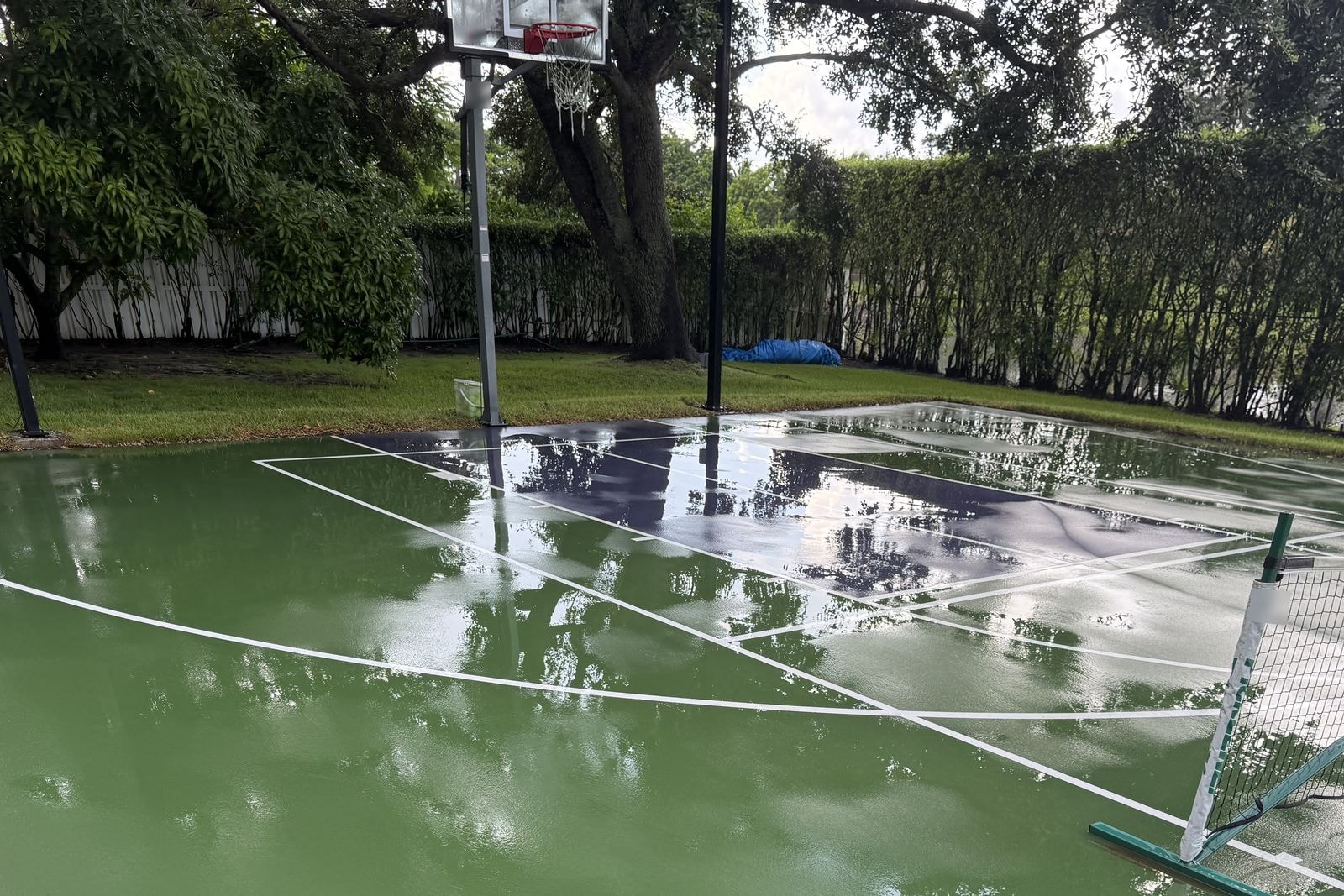
The same court before and after soft washing. The after image was taken immediately on completion, so the surface is still wet.
Why Six Months, Specifically
The interval isn't arbitrary. It's tied to how growth cycles in a subtropical climate.
Biological regrowth on an outdoor surface here typically becomes visible again somewhere between four and eight months after a proper kill, depending on shade, tree cover, and irrigation exposure. Six months puts the cleaning ahead of the visible stage rather than behind it — which matters, because established growth is harder to remove and has already begun holding moisture against the coating.
It also lines up cleanly with the South Florida calendar:
Fall cleaning (October–November): Removes everything the rainy season deposited and kills the growth it started, right before peak season play and snowbird arrival.
Spring cleaning (April–May): Clears winter pollen and organic buildup and puts a clean, treated surface into the wet season instead of a colonized one.
Courts under heavy tree canopy, courts with irrigation heads throwing onto the playing surface, and courts in constant shade may need a shorter interval. Full-sun courts with good drainage sometimes stretch it. Six months is the baseline that works for most properties in Palm Beach, Broward, and Martin Counties.
Court by Court
Tennis courts. Sliding and pivoting on a contaminated surface is where injuries happen. Beyond safety, embedded soil and ball fuzz change how the court plays — the surface slows, the bounce gets inconsistent, and the color coat looks tired long before it's actually worn out. Clean courts also make line calls easier, because faded lines against a dark, mottled surface are genuinely hard to see.
Pickleball courts. These take the heaviest play volume per square foot of any court type right now, and much of the action happens in a small area at the non-volley zone where footing matters most. Many pickleball courts are also striped over existing tennis surfaces, meaning two sets of lines competing for visibility — one more reason not to let the surface darken. The lighter ball is more sensitive to surface grit than a tennis ball, so contamination shows up in play sooner.
Basketball courts. Outdoor basketball surfaces get the least maintenance attention and see the most falling down. Algae film on a court that's damp from morning dew is genuinely slick, and players go to the ground on this surface by design. Shaded half-courts and courts backed up against a wall or hedge grow the fastest.
The Liability Angle for HOAs, Clubs, and Schools
If you sit on an HOA board or manage a community amenity, this is the part worth flagging to the rest of the board.
Algae on a wet court is a slip hazard, and it's a visible one. A documented, scheduled maintenance program shows the community treated a known condition as a known condition and addressed it on a regular interval. An unscheduled, reactive approach — cleaning only after a complaint or an incident — reads very differently.
For HOA amenities, the six-month cycle also does something practical: it puts the court on a line item and a calendar instead of on somebody's mental list.
The Math on Resurfacing
Resurfacing an acrylic court is a real capital expense — commonly several thousand dollars per court, and more for cushioned systems or courts needing crack repair first. Coating systems have a service life measured in years, and that life is shortened by two things: water intrusion and biological growth holding moisture against the surface.
Two soft washes a year is a small fraction of a resurfacing cost. Deferring cleaning doesn't save that money — it moves the resurfacing date closer.
Signs Your Court Is Overdue
Green or black film that darkens noticeably after rain
Dark shadowing along the fence line, in corners, or under tree canopy
Lines that have become hard to read from the baseline
A surface that feels slick underfoot when damp
Discoloration that returns within weeks of the last cleaning — a sign the previous cleaning removed growth without killing it
What Our Court Cleaning Service Includes
We've been soft washing sports courts across Palm Beach, Broward, and Martin Counties since 2014 — residential courts, HOA amenities, clubs, and schools.
Every court job includes:
Low-pressure application of professional cleaning solution with proper dwell time
Full rinse at a pressure safe for acrylic color coats and line paint
Fence, gate, and windscreen cleaning
Surrounding deck and walkway surfaces as needed
Landscape protection and pre-wetting around the work area
A recommended return interval based on your court's specific shade, drainage, and irrigation exposure
We're also happy to put HOA and commercial properties on a standing semiannual schedule so it's handled without anyone having to remember to call. You can see our sports court cleaning projects for examples of what a proper soft-wash result looks like.
Schedule Your Court Cleaning
Ready to schedule your court cleaning? Request a free estimate or call us at (561) 907-1333. We serve Palm Beach, Broward, and Martin Counties and are happy to set HOA and commercial properties on a standing semiannual schedule.
If you've received a letter about your roof or driveway, you're not alone — exterior appearance is one of the most commonly enforced categories in South Florida HOA communities. Here's what's usually behind it.
Licensed, Bonded & Insured·A+ Rating with the BBB·5 Stars on Angi·5 Stars on Yelp·Nextdoor Neighborhood Fave '24 & '25·Serving South Florida Since 2014·24-Hour Response